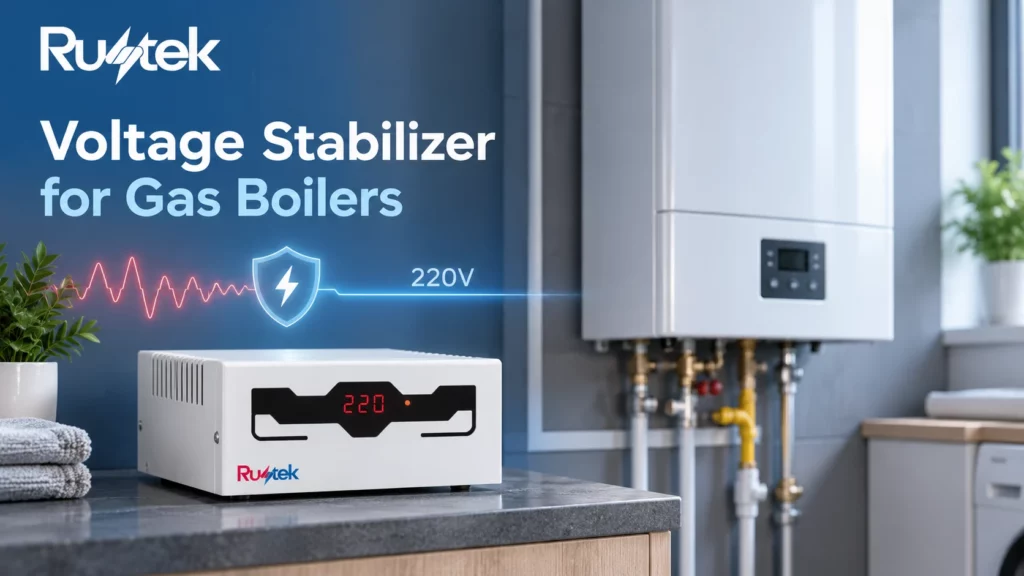
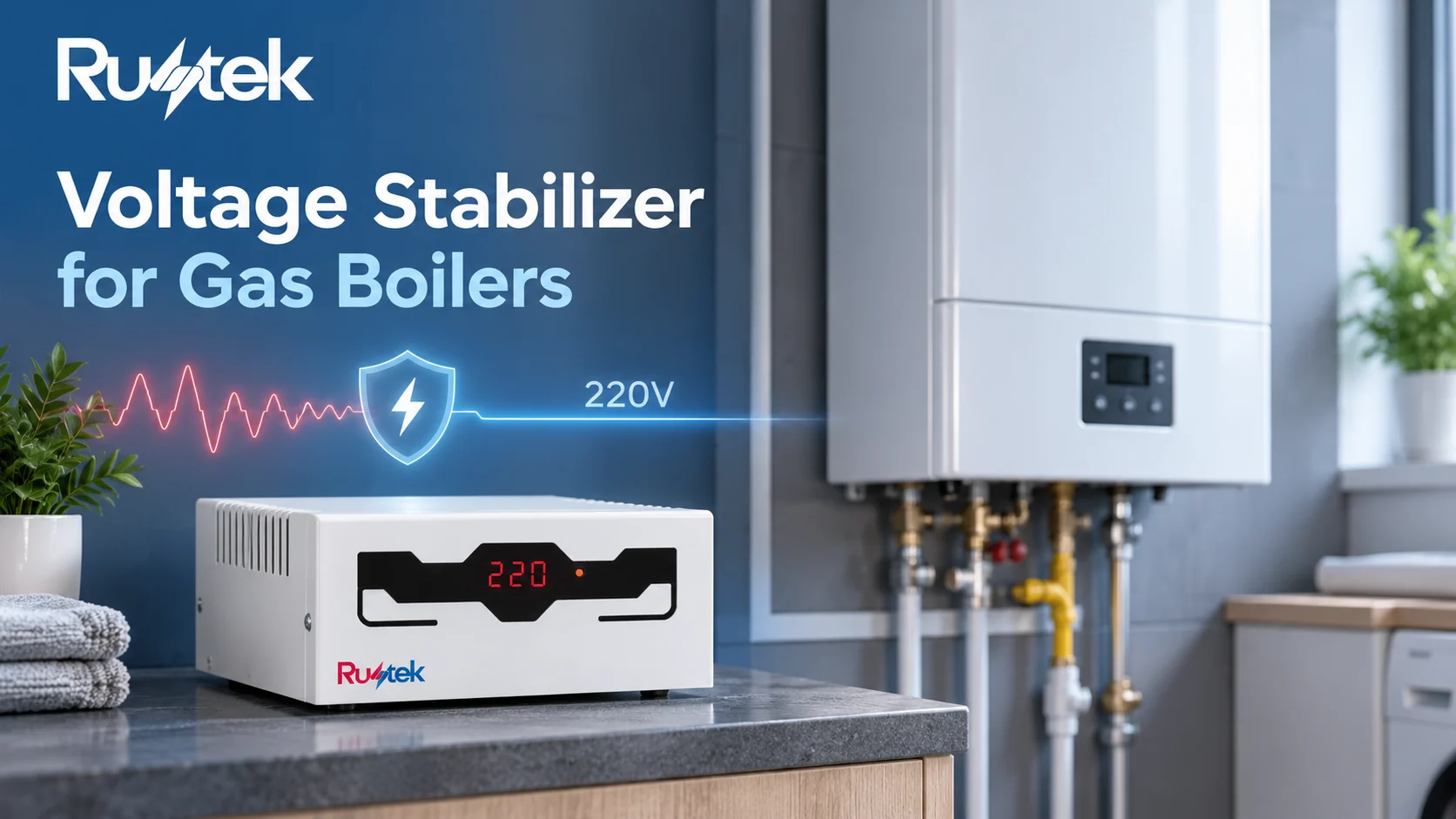
A gas boiler burns natural gas to produce heat, but it still needs electricity to operate. Its control board, circulation pump, ignition system, and fan all depend on a suitable electrical supply.
This becomes a problem in homes where the mains voltage regularly drops during peak hours or rises unexpectedly. The boiler may display error codes, restart, or stop heating altogether.
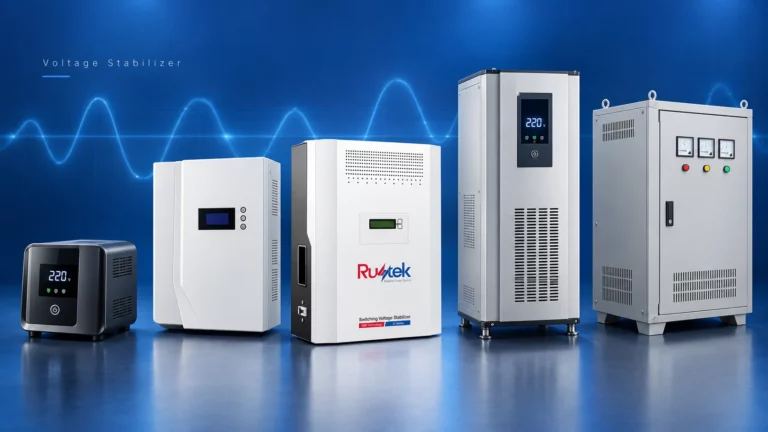
A gas boiler voltage stabilizer regulates the incoming voltage before it reaches the heating equipment. However, selecting the right model requires more than choosing the first AVR with enough wattage. If you are unfamiliar with automatic voltage regulators, read Rustek's guide to choosing a home voltage stabilizer for an introduction to voltage regulation, capacity, and household protection.
Here, we focus specifically on gas boilers and the electrical requirements that distinguish them from other appliances.
Why Does a Gas Boiler Need Stable Voltage?
Modern gas boilers combine mechanical heating components with electronic control systems. The electronic board monitors temperature, water pressure, flame detection, and operating sequences. The circulation pump moves heated water through the system, while the fan and ignition components support safe combustion. These components can react differently to voltage problems.
During significant undervoltage, motors may struggle to start or operate correctly. Electronic power supplies may shut down or cause the boiler controller to reset. Excessive voltage can place additional electrical stress on sensitive components and trigger a shutdown.
Not every voltage fluctuation will damage a boiler. Many modern systems tolerate a reasonable operating range. Problems become more likely when the supply repeatedly exceeds the manufacturer's permitted limits. A boiler stabilizer is especially useful in these conditions.
Does Every Gas Boiler Need a Voltage Stabilizer?
Before purchasing a stabilizer, check the boiler manufacturer's electrical specifications. Compare the permitted input-voltage range with the minimum and maximum voltage measured at your home, and note how often abnormal voltage occurs.
If the supply consistently remains within the boiler's specified limits, additional voltage regulation may not be necessary. If measurements show frequent drops or increases beyond those limits, an appropriately selected automatic voltage regulator for the boiler is worth considering.
Do not assume that every boiler shutdown is electrical. Low gas pressure, circulation faults, ignition problems, and defective sensors can produce similar symptoms.
How Does a Voltage Stabilizer Protect a Gas Boiler?
A boiler voltage stabilizer continuously monitors the mains supply and adjusts the voltage delivered to the equipment. When the voltage falls below the desired level, the stabilizer raises it. When it becomes too high, the stabilizer reduces the output.
This automatic correction maintains a more consistent electrical environment for the boiler's control electronics and motor-driven components.
For ordinary residential applications, relay-based voltage stabilizers can offer a practical and affordable solution. They select different transformer taps to compensate for changing input voltage. This stepwise correction is often sufficient for household boilers, provided the resulting output remains within the boiler manufacturer's tolerance.
More expensive servo or static electronic regulators may offer advantages in specific installations, but their additional precision is not automatically necessary for every domestic heating system. A suitable input range and output accuracy matter more than choosing the most sophisticated technology.
What Size Voltage Stabilizer Does a Gas Boiler Need?
This is where many buyers become confused. A boiler advertised as 24 kW does not necessarily consume 24 kW of electricity. That figure normally describes its thermal heating capacity, not the electrical power required by its controls, fan, and pump.
When sizing a stabilizer, use the boiler's electrical consumption rather than its heating output.
Calculate the Total Electrical Load
Start with the maximum electrical power or current stated in the boiler's technical documentation. Then determine whether the heating installation includes additional electrical loads, such as:
- External circulation pumps
- Zone-control equipment
- Auxiliary controllers
- Other components supplied through the same stabilizer
Do not count the boiler's built-in pump twice if its consumption is already included in the manufacturer's total electrical rating. You should also consider motor starting current and power factor.
Stabilizer capacity is usually expressed in volt-amperes (VA), while appliance consumption is commonly expressed in watts (W). These values are not always equal. A basic estimate is:
Required VA = Total running watts ÷ Power factor
For many small domestic boilers, a 1000 VA stabilizer may be a reasonable starting point. The correct rating, however, depends on the actual equipment and connected loads. A 1 kVA or 2 kVA stabilizer is commonly sufficient for a wall-mounted domestic boiler, subject to verification.
Five Specifications to Check Before Buying
- Input voltage range: it must cover the lowest and highest voltage measured at the installation.
- Output voltage and accuracy: the regulated output must remain within the boiler manufacturer's permitted range.
- Response time: correction should be fast enough for the type of fluctuations present.
- Electrical compatibility: verify voltage, frequency, phase, capacity, and connection requirements.
- Restart delay and protection: check delay settings, overload protection, and safe recovery after an interruption.
Also verify the stabilizer's operating temperature and electrical installation requirements.
Rustek ECO Voltage Stabilizers for Gas Boilers
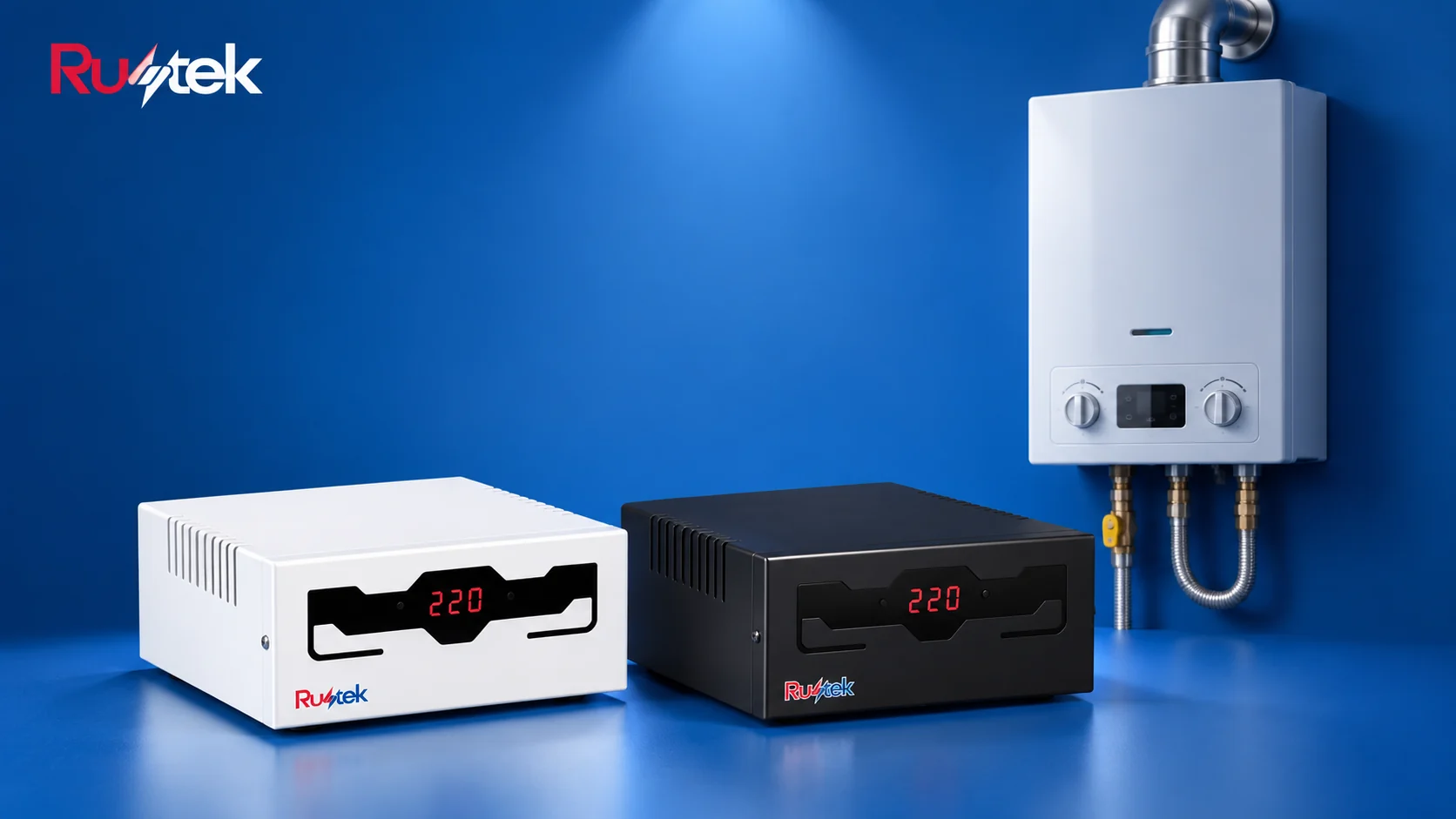
For residential boilers exposed to unstable mains voltage, the Rustek ECO Appliance Voltage Stabilizer Series provides a compact appliance-level regulation option.
The series includes three single-phase models:
| Model | Rated capacity |
|---|---|
| ECO 1000 Full | 1000 VA |
| ECO 2000 Full | 2000 VA |
| ECO 3000 Full | 3000 VA |
For a typical wall-mounted boiler, ECO 1000 Full may be the first model worth evaluating. Heating installations with additional pumps or electrical equipment may require a higher capacity.
The final choice must be checked against the boiler's electrical requirements, starting demand, and measured supply conditions. See the Rustek ECO Appliance Voltage Stabilizer Series for detailed specifications and available models.
Choosing the Right Protection for Your Heating System
A gas boiler voltage stabilizer does not need to be unnecessarily large or expensive. It needs to match the heating system's actual electrical demand and the voltage conditions at the installation. Start with the boiler manual, measure the incoming voltage, and account for connected pumps and controls.
With that information, choosing a suitable Rustek ECO model becomes much easier, and the heating system receives protection based on its real requirements rather than guesswork. Contact Rustek for a free consultation.
Frequently Asked Questions
Can low voltage or overvoltage damage a gas boiler's electronic board?
Yes. Voltage outside the equipment's permitted limits can cause operational faults and electrical stress. The actual risk depends on the boiler design, the voltage deviation, and the duration of exposure.
Can I connect a gas boiler and an external pump to one stabilizer?
Potentially, yes. The stabilizer must accommodate their combined operating demand and starting currents, and the electrical connection must comply with both manufacturers' requirements.
What is the best stabilizer capacity for a boiler?
It depends on the specifications of the boiler and stabilizer. A 1 kVA relay-based voltage stabilizer is often sufficient for a wall-mounted domestic gas boiler, but the rating must be confirmed from actual electrical demand and starting current.
Will a voltage stabilizer keep my boiler running during a blackout?
No. A standalone voltage stabilizer does not provide backup electricity. Continued operation during an outage requires a suitable UPS or another backup power source.