4 models
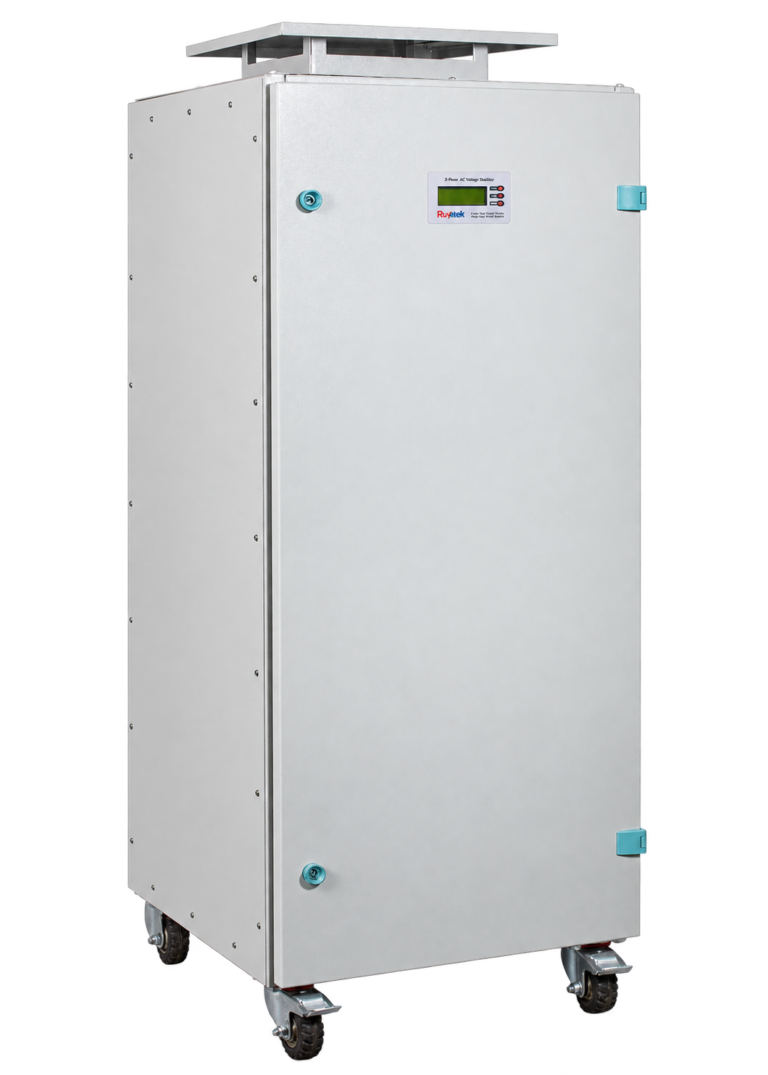
Rustek 3XP Series Industrial Three-Phase Voltage Stabilizer
Rustek 3XP Series three-phase automatic voltage regulators are available in 60, 80, 120 and 150 kVA models for industrial, light-industrial and commercial…
View product →Explore three-phase automatic voltage regulators for industrial facilities, commercial buildings and equipment supplied by three-phase power. Choose a stabilizer around your actual load, incoming voltage conditions and installation requirements.
Review the models below for rated capacity, input voltage range, nominal current and available technical documents. Confirm suitability against your site measurements before ordering.
Rustek 3XP Series three-phase automatic voltage regulators are available in 60, 80, 120 and 150 kVA models for industrial, light-industrial and commercial…
View product →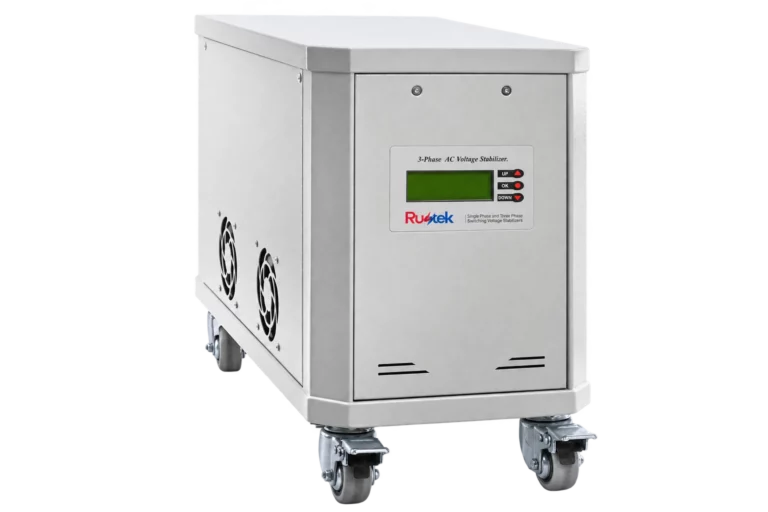
Rustek 3XP three-phase automatic voltage regulators in 10, 20, 30 and 45 kVA models for workshops, light industry and commercial three-phase installations.
View product →A three-phase voltage stabilizer, also called a three-phase automatic voltage regulator or 3-phase AVR, adjusts incoming AC voltage within its specified operating range to provide a more consistent supply to connected loads. It is considered where sustained low voltage, high voltage or recurring voltage fluctuations affect equipment operation.
The correct unit must match both the electrical supply and the equipment. Total kVA alone does not establish suitability: check line voltage, frequency, current on each phase, load characteristics and the manufacturer’s limits. A stabilizer regulates voltage; it does not create an unlimited power supply or replace a properly designed electrical installation.
Different loads place different demands on an industrial voltage stabilizer. Use the application to define what needs checking, then compare the actual model specifications.
Production machinery and control equipment may share a supply with large switching loads. Record voltage conditions during normal operation and peak production, and assess whether regulation is required for an individual machine or a distribution board.
Motor starting demand can be substantially higher than running demand. Check the starting method, acceleration time and simultaneous starts. Compatibility with drives, control circuits and the selected AVR must be verified for the actual installation.
Facilities can combine three-phase machinery with single-phase lighting, electronics and other circuits. Review the distribution of loads, neutral requirements and current limits on each phase instead of treating the building as one evenly balanced load.
Elevators require stable three-phase power for safe and reliable operation. Three-phase voltage stabilizers & Automatic regulators protect elevator motors, control panels and drive systems against voltage fluctuations, overvoltage, undervoltage and phase imbalance, helping prevent low efficiency working, unexpected shutdowns, equipment damage and costly maintenance.
Build the selection around measured conditions and the connected equipment. These checks help distinguish a suitable three-phase AVR from a unit that simply has a large capacity label.
| Selection factor | What to verify |
|---|---|
| Rated capacity and current | Compare continuous apparent power in kVA and the permitted current per phase with the loads operating at the same time. Keep kW and kVA distinct; power factor affects their relationship. |
| Input voltage range | Measure the lowest and highest supply voltage on each phase. Confirm the usable load capacity at those conditions, including any manufacturer-specified derating at low input voltage. |
| Output voltage and accuracy | Match the nominal output and stated regulation tolerance to equipment requirements. Supply labels such as 380 V, 400 V or 415 V do not establish that every model supports each voltage. |
| Starting and changing loads | Check motor inrush, overload duration, starting sequence and rapid changes in demand. Select against documented performance rather than using an arbitrary capacity multiplier. |
| Phase loading and neutral | Verify phase-current limits, allowable imbalance, wiring configuration and neutral requirements. Independent phase regulation is a model-specific feature, not an assumption. |
| Protection and bypass | Review the actual protection functions, trip thresholds and bypass arrangement. Coordinate these with upstream and downstream protective devices and maintenance requirements. |
| Installation conditions | Check indoor or outdoor suitability, enclosure rating, ambient temperature, ventilation clearances, cable access and service space against the installation manual. |
A standalone voltage stabilizer does not provide battery backup during a power cut. Where continuity is required, assess an appropriate UPS or other backup arrangement separately. Also confirm which surge, phase-loss and phase-sequence protections are actually included in the selected model.
For a mixed-load installation, an acceptable total load can still conceal an overloaded phase. Check phase currents individually and have the distribution assessed before selecting equipment. A voltage regulator must not be assumed to redistribute current between phases or repair supply and wiring faults.
Have the final equipment selection and installation checked by a qualified electrical professional using the manufacturer’s documentation and the site’s actual conditions.
They are designed for different supply configurations. A single-phase regulator serves a compatible single-phase circuit, while a three-phase unit is designed for a specified three-phase supply. Choose according to the supply, connected loads and approved wiring arrangement, not capacity alone.
Start with the simultaneous load, measured phase currents and equipment power-factor information. Then account for starting demand and the selected model’s operating limits. There is no universal kVA recommendation without the site and equipment data.
Some installations supply single-phase circuits from a three-phase distribution system. Suitability depends on the AVR’s approved wiring configuration, neutral provision, phase-current ratings and permitted imbalance. Confirm these points for the specific model.
Do not assume it does. Some models regulate phase voltages independently, but this is not the same as balancing load currents. Check the specified voltage-regulation method and imbalance limits, and assess the load distribution separately.
It may be suitable when correctly specified. Selection must consider starting current, start duration, the number of simultaneous starts and compatibility with motor controls. Running power on its own is not sufficient.
A standalone stabilizer cannot continue supplying power when the incoming supply is lost. Battery-backed continuity is a separate function provided by an appropriately specified UPS or backup system.
Three-phase voltage stabilizers are available with servo-controlled, relay-based and static electronic regulation technologies. Each of them offers different levels of accuracy, response speed, durability and maintenance requirements. When choosing a stabilizer, check its regulation technology and specifications to ensure it matches your application.
Send the nominal supply voltage and frequency, measured voltage range on each phase, equipment list, running current or power, motor starting details and installation environment. Include any requirements for bypass, backup power or specific protection functions.
Share your load details and measured supply conditions with Rustek to discuss a suitable model and the specifications that need confirmation.