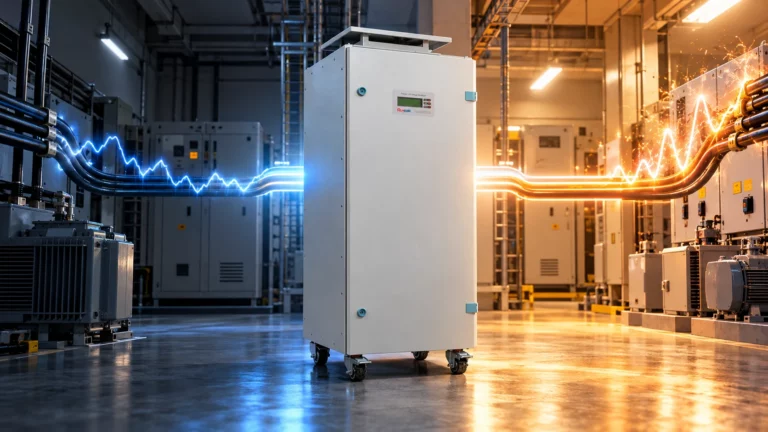
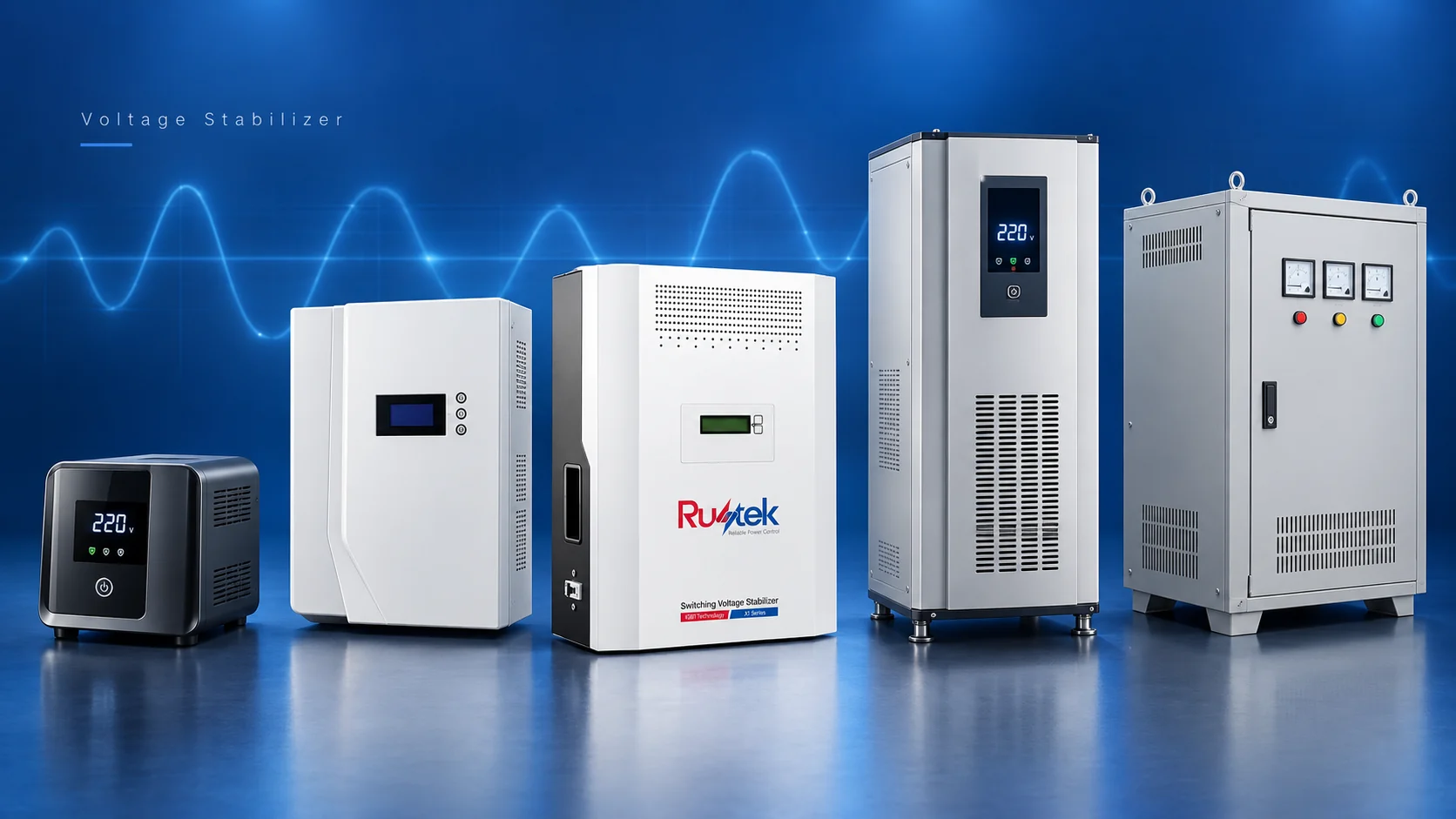
A voltage stabilizer, also called an automatic voltage regulator or AVR, is an electrical device that corrects changes in incoming voltage before supplying connected equipment.
When voltage is too low, the regulator raises it. When voltage is too high, it reduces it. This automatic process helps equipment operate within a more suitable electrical range.
The principle is simple, but real performance depends on regulation technology, input range, capacity, response time, accuracy, and protection functions.
What Is an Automatic Voltage Regulator?
An automatic voltage regulator continuously measures the electrical supply. Its controller compares the measured voltage with a target or permitted output range and commands the regulation system to make a correction when required.
The terms voltage stabilizer and automatic voltage regulator are commonly used for equipment that performs this function. The exact construction varies from small appliance regulators to large three-phase industrial systems.
A stabilizer does not generate electricity. It regulates the voltage already available from the supply and can do so only within its rated input and load limits.
How Does a Voltage Stabilizer Work?
The process has four basic stages:
- Measurement: sensors continuously monitor the incoming voltage.
- Comparison: the controller compares the measured value with the configured output.
- Correction: relays, a servo mechanism, or electronic switches increase or decrease voltage.
- Protection: if voltage or load exceeds safe limits, the device may disconnect the output and report a fault.
When input voltage is low, the stabilizer uses a boost function. When it is high, it uses a buck function. Output accuracy and correction speed depend on the technology and model.
A Simple Example of Voltage Regulation
Assume an appliance is intended to operate near 230 V:
- If the supply falls to 190 V, a compatible stabilizer boosts the output toward its target.
- If the supply rises to 255 V, the stabilizer reduces the output.
- If the supply moves beyond the stabilizer's supported range, protection may disconnect the load.
The stabilizer must have sufficient capacity for the connected load. A motor or compressor may require considerably more current during startup than during normal operation.
Three Main Voltage-Stabilizer Technologies
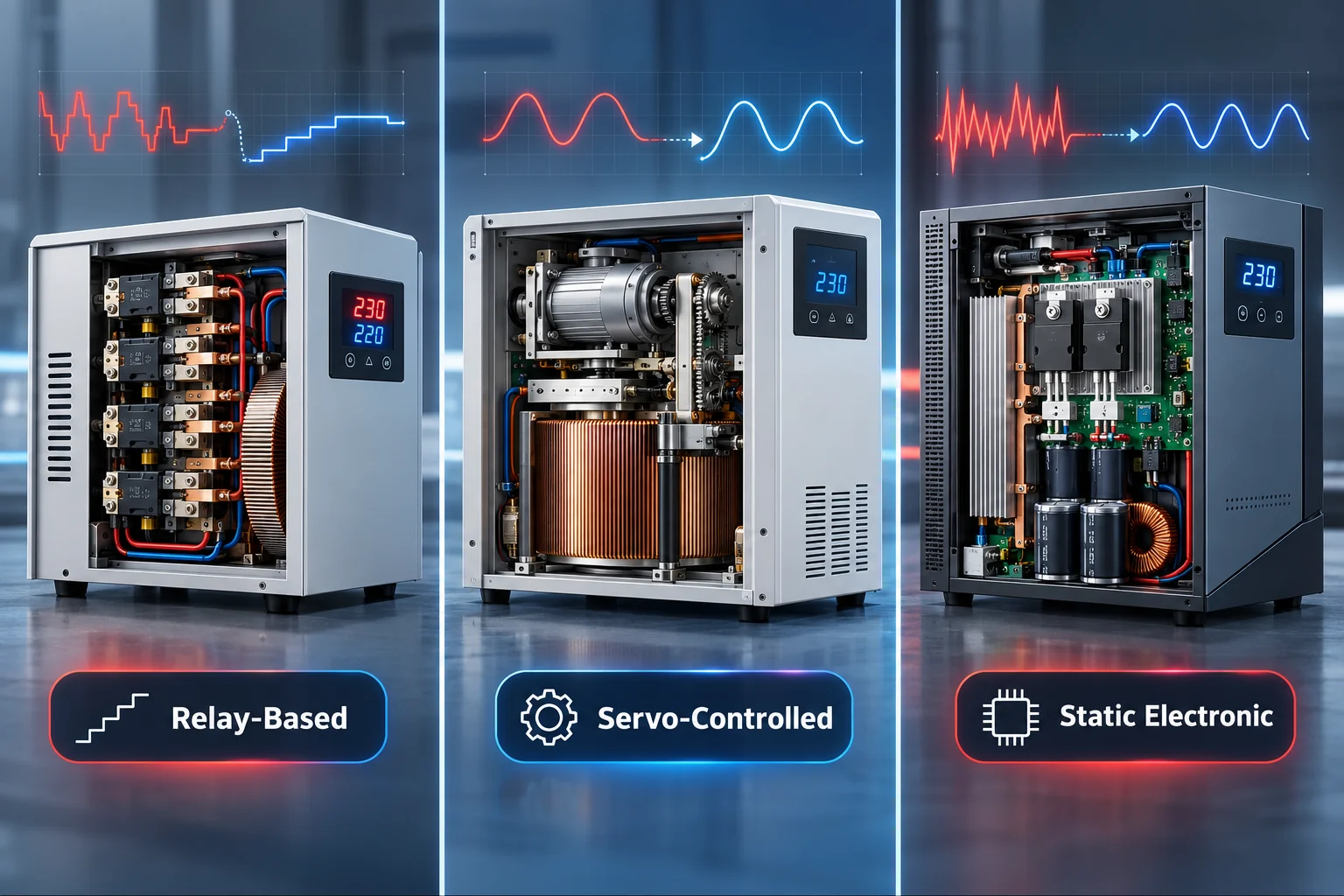
Relay-Based Voltage Stabilizers
Relay-based stabilizers switch between transformer taps to increase or decrease voltage in defined steps. They are commonly used for household appliances, homes, and general-purpose loads because they offer practical regulation at an accessible cost.
Output changes in steps, and switching may produce audible clicks. The step size, accuracy, and relay life vary by model.
Servo-Controlled Voltage Stabilizers
A servo stabilizer uses a motor-driven contact and variable transformer to make continuous adjustments. It can provide smooth, accurate output after completing the mechanical correction.
The motor and contact mechanism introduce response delay, sound, and maintenance requirements. Servo systems remain useful for many conventional commercial and industrial loads.
Static Electronic Voltage Stabilizers
Static stabilizers use electronic power-control components, including IGBT-based designs, to produce the required correction without a motorized regulating mechanism.
They can provide fast response, high accuracy, and reduced mechanical maintenance. This technology is particularly relevant to sensitive electronics, medical systems, industrial controls, telecommunications equipment, and cryptocurrency miners.
The most sophisticated technology is not automatically the best. Selection should match the response speed, accuracy, load, environment, maintenance plan, and budget. See the detailed servo versus static stabilizer comparison.
What Happens Outside the Stabilizer's Limits?
Every stabilizer has a specified input operating range. A unit rated for 155–265 V is intended to regulate within those limits under specified load conditions.
If input voltage falls below the minimum or rises above the maximum, the regulator may no longer maintain its rated output. Protection may disconnect the load, issue a fault, or follow another manufacturer-defined action.
At low input voltage, a stabilizer may draw more current to maintain output power. Some models therefore have reduced usable capacity near the lower end of their range. The headline kVA rating alone does not describe the complete operating capability.
Can a Stabilizer Protect Against Every Electrical Problem?
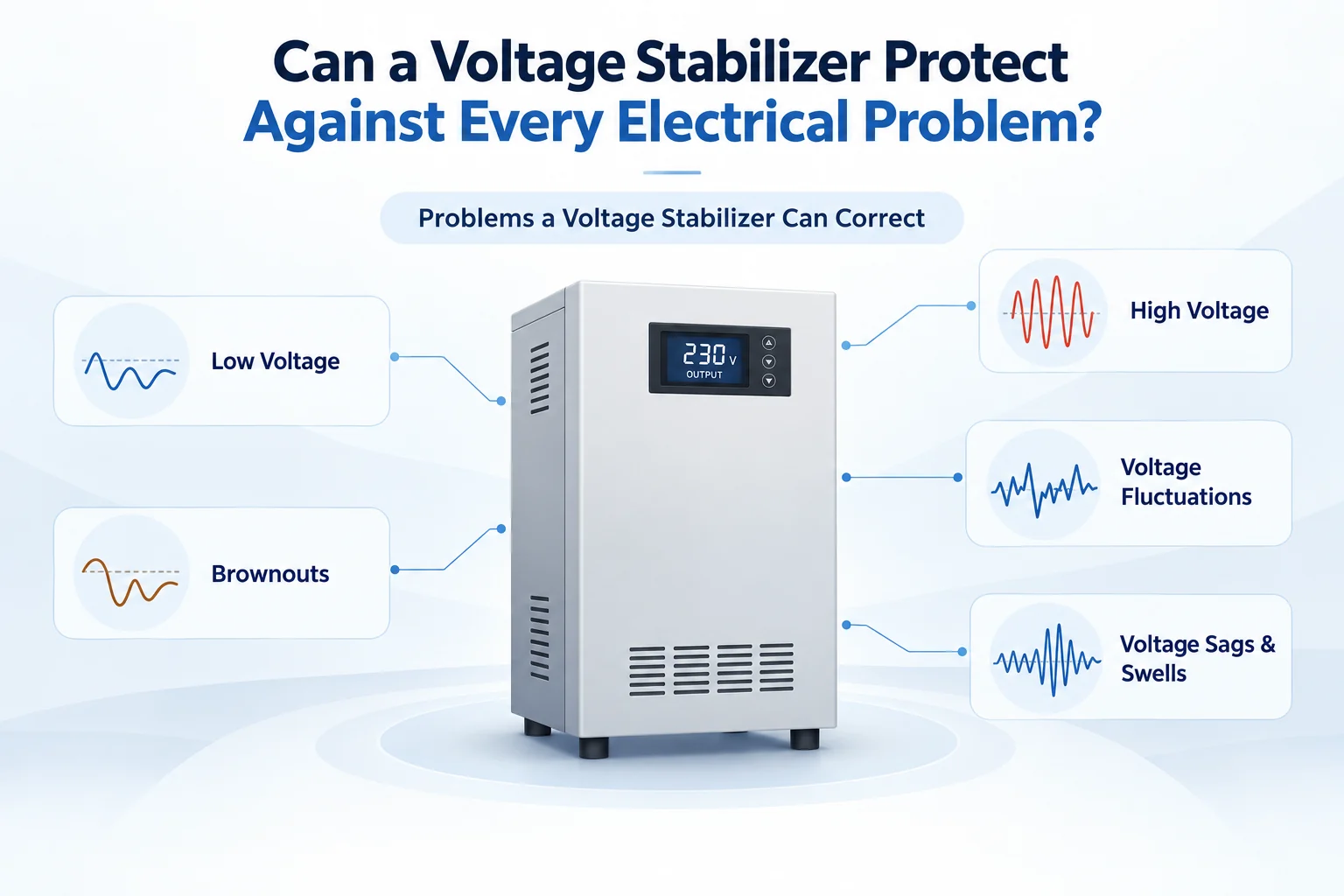
No. Voltage regulation is only one part of electrical protection. A conventional AVR primarily corrects eligible low and high voltage within its operating range.
It should not automatically be expected to eliminate lightning transients, frequency deviations, harmonic distortion, unsafe wiring, poor earthing, or a complete outage. These conditions may require surge protection, filters, electrical repairs, a UPS, or a generator.
A voltage protector also differs from a regulator. Many protectors disconnect the load when voltage becomes unsafe, while an AVR actively corrects voltage inside its range. Some Rustek stabilizers combine regulation with cut-off protection, overload protection, thermal monitoring, and restart delay.
Does a Voltage Stabilizer Work During a Power Outage?
No. A standalone stabilizer cannot continue powering equipment after the mains supply disappears. It regulates available electricity but does not store energy.
A UPS contains or connects to energy storage and can supply temporary power. Some line-interactive UPS systems also include limited automatic voltage regulation, but their capacity, efficiency, runtime, and cost differ from a dedicated stabilizer.
Single-Phase and Three-Phase Voltage Regulation
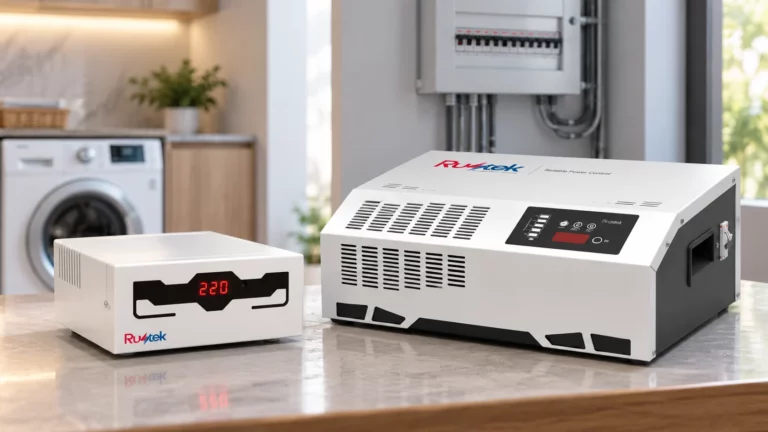
Single-phase stabilizers are commonly used for household appliances, homes, offices, and compatible single-phase equipment.
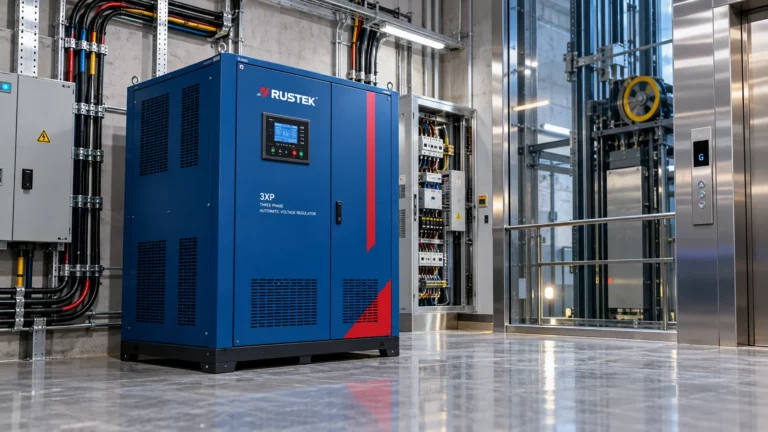
Three-phase stabilizers are intended for industrial machinery, commercial facilities, large motors, elevators, and other three-phase loads. Some models regulate each phase voltage independently, but independent voltage regulation does not automatically balance the load current between phases.
Always check nominal phase voltage, line voltage, wiring configuration, neutral requirements, current per phase, phase sequence, and protection functions. See Rustek's three-phase voltage regulators.
How to Choose the Right Voltage Stabilizer
- Measure the input range: record the lowest and highest voltage during actual operation.
- Identify the connected load: calculate the equipment that may operate simultaneously.
- Calculate capacity: consider VA or kVA, power factor, starting current, and overload ratings.
- Confirm output accuracy: match it to the equipment's permitted input range.
- Select the technology: compare speed, accuracy, maintenance, environment, and budget.
- Review protection and installation: check overload, thermal limits, restart delay, bypass, ventilation, earthing, and electrical safety.
For motor-driven loads, starting current is particularly important. Also decide whether you need centralized protection or a dedicated appliance regulator. Read the comparison of a whole-house versus single-appliance stabilizer.
How Rustek Approaches Automatic Voltage Regulation
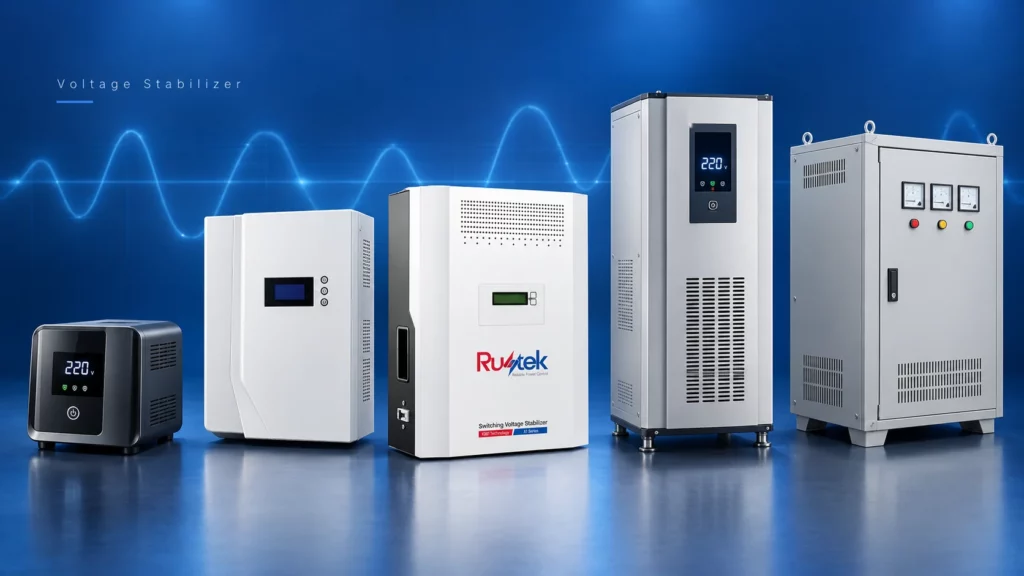
Rustek offers single-phase and three-phase stabilizers using relay-based and static electronic technologies for different electrical requirements. Each product family addresses a different combination of capacity, input range, accuracy, speed, and application.
Selection begins with measured voltage conditions, actual electrical demand, and the equipment being protected. Explore Rustek voltage stabilizers to compare available product families.
Understanding Regulation Makes Selection Easier
A voltage stabilizer measures the incoming supply, determines whether correction is necessary, and adjusts voltage before delivering it to connected equipment. Relays, servo motors, and electronic switches provide different balances of cost, accuracy, speed, and maintenance.
The right AVR is the one that keeps equipment within its electrical requirements under the actual conditions of the installation—not simply the model with the largest kVA rating or the most advanced technology.
Frequently Asked Questions
Can a voltage stabilizer reduce electricity bills?
Not necessarily. Its primary purpose is voltage regulation. Any effect on energy consumption depends on the connected loads, supply conditions, and the stabilizer's own losses.
Does every appliance need an automatic voltage regulator?
No. Many appliances tolerate a specified input range. Compare that range with actual voltage measurements before adding regulation.
What are the main voltage-stabilizer technologies?
The three common types are relay-based, servo-controlled, and static electronic stabilizers. They differ in response speed, accuracy, maintenance, and cost.
Can a stabilizer supply power during an outage?
No. A suitable UPS, battery system, generator, or other backup source is required.