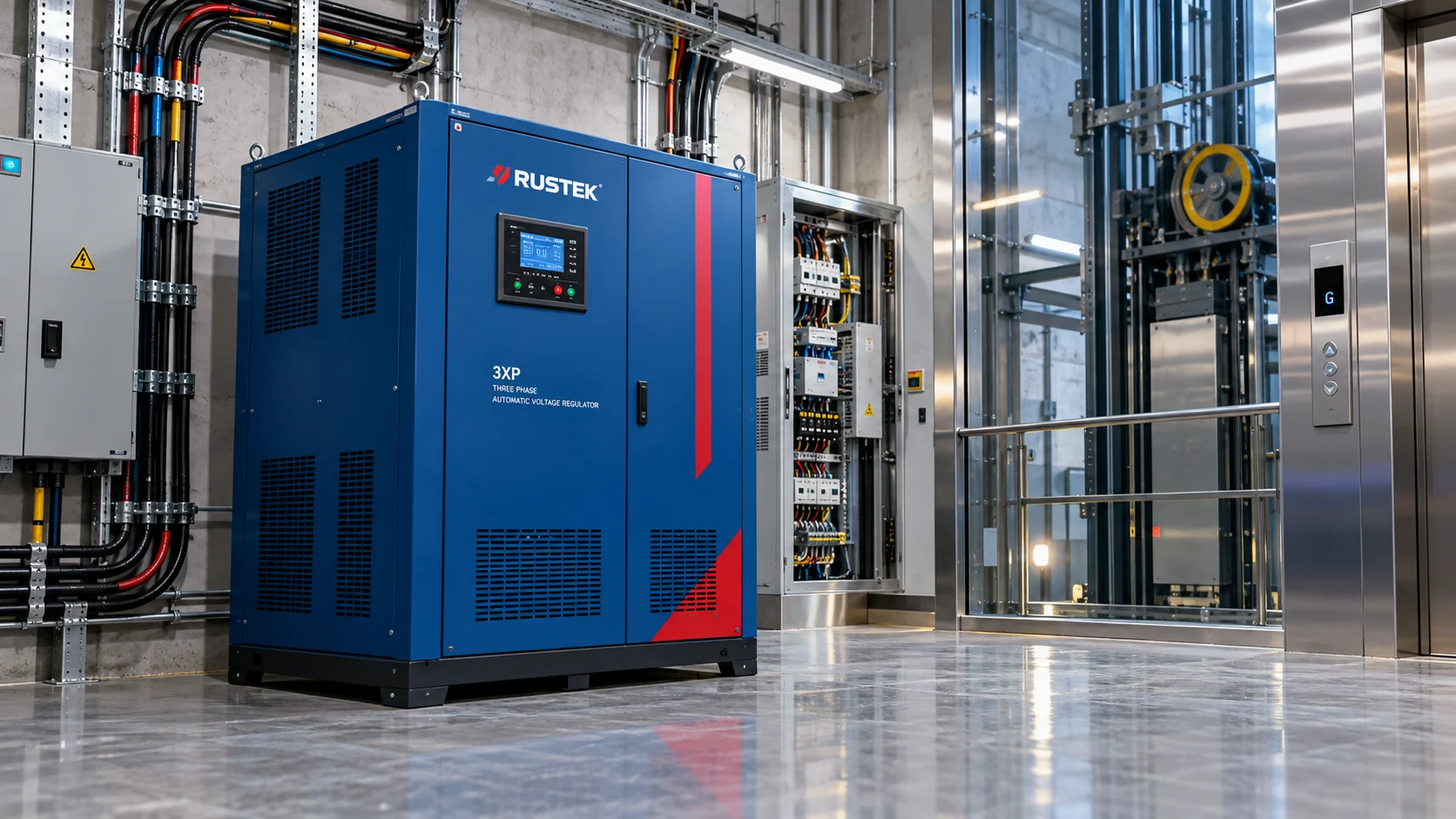
An elevator may operate perfectly for months and then begin showing drive errors, unexpected shutdowns, or startup problems. Sometimes the cause is not the elevator itself, but the quality of the electricity supplying it.
Voltage fluctuations can affect elevator motors, electronic controllers, and drive systems, especially in buildings where electrical demand changes throughout the day. A correctly selected elevator voltage stabilizer can provide a more consistent supply and reduce interruptions caused by unstable voltage.
However, a stabilizer is not automatically suitable for every elevator, escalator, or lift. Before purchasing one, you need to understand the electrical system, the required capacity, the measured voltage range, and the limitations of the selected technology.
Why Would an Elevator Need a Voltage Stabilizer?
Elevators rely on several electrical components working together. A traction motor or hydraulic pump provides movement, the controller manages operation, and the drive regulates motor speed and torque. Door operators, brakes, and auxiliary circuits also depend on a suitable electrical supply.
When incoming voltage repeatedly falls below or rises above the permitted range, the following problems may occur:
- The elevator drive may report undervoltage or overvoltage faults.
- Control electronics may reset unexpectedly.
- Motors and electrical components may experience additional thermal and electrical stress.
- The elevator may remain unavailable until the fault is cleared.
These symptoms do not prove that a stabilizer is required. Loose connections, inadequate cabling, defective components, poor earthing, and incorrect drive settings can cause similar problems. The first step is to measure the incoming voltage while the elevator operates, preferably during periods of high building demand.
How Does an Elevator Voltage Stabilizer Work?
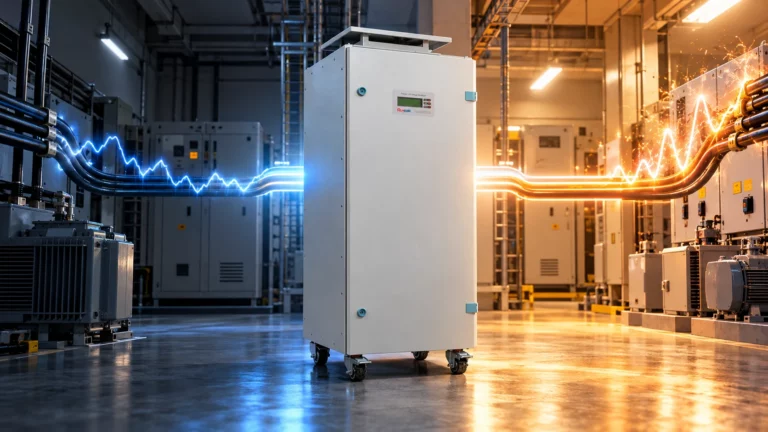
An elevator voltage stabilizer, also called an automatic voltage regulator or AVR, monitors the incoming supply and adjusts the voltage when it moves outside the desired operating range.
If the building supply drops below the elevator's required level, a compatible AVR can boost the output toward its configured value, provided the input remains within the stabilizer's operating limits. If the supply becomes too high, the stabilizer reduces the output. It is normally installed on the supply side of the elevator control system according to an approved electrical design.
A stabilizer must not be confused with a variable-frequency drive. The VFD controls motor speed and torque; the stabilizer regulates the incoming supply voltage. A stabilizer also cannot operate an elevator during a complete outage. Emergency operation requires a separately designed UPS, generator, or automatic rescue system.
How to Choose the Right Voltage Stabilizer for an Elevator
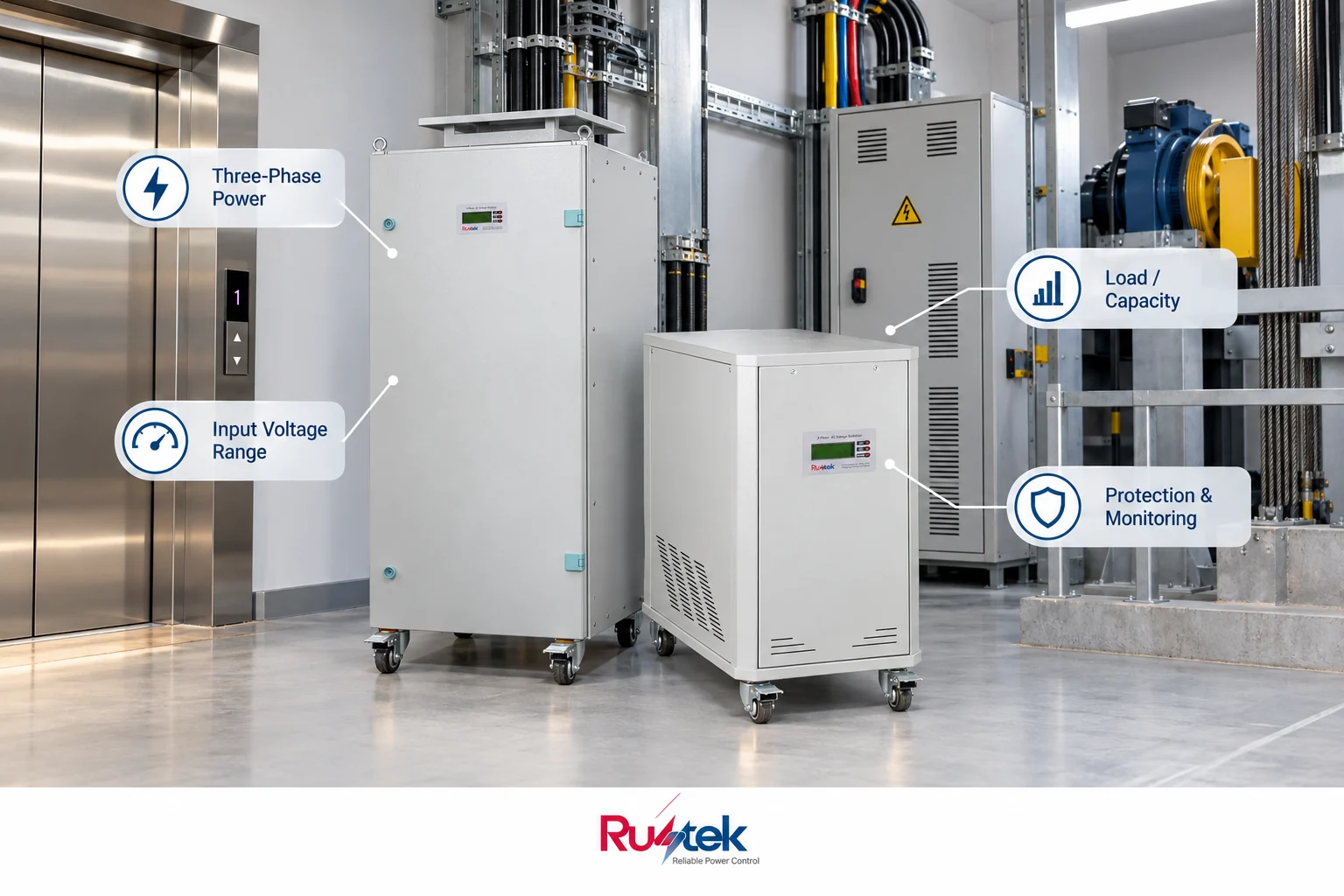
1. Confirm Whether the Elevator Uses Single-Phase or Three-Phase Power
Start with the elevator's electrical documentation rather than the building type. Most conventional commercial traction elevators use three-phase power, while some smaller residential lifts use a different supply.
For a three-phase elevator, a compatible three-phase stabilizer is generally the starting point. It must match the nominal voltage, frequency, wiring arrangement, neutral requirements, and current demand. Never assume that every three-phase stabilizer supports every three-phase voltage standard.
2. Calculate the Required Stabilizer Capacity
A common mistake is choosing capacity from the elevator motor's rated power alone. Stabilizers are normally rated in kilovolt-amperes (kVA), while motor power is often stated in kilowatts (kW).
For a balanced three-phase system, apparent power can be estimated as:
kVA = (1.732 × line-to-line voltage × line current) ÷ 1000
This calculation is only a starting point. Final selection must also consider:
- Motor starting or acceleration current
- Elevator drive and controller characteristics
- Other connected electrical loads
- Maximum simultaneous demand
- Operation at the lowest measured input voltage
- The stabilizer's overload capability
Capacity should be verified for the actual installation. See Rustek's voltage stabilizer sizing guide for additional calculation guidance.
3. Check the Measured Input-Voltage Range
Two stabilizers with the same kVA rating may behave differently when the incoming voltage falls. Record the minimum and maximum voltage on every phase, then confirm that the stabilizer can regulate throughout that range while supporting the required load. Some products have reduced usable capacity at very low input voltage.
4. Compare Voltage-Regulation Technologies
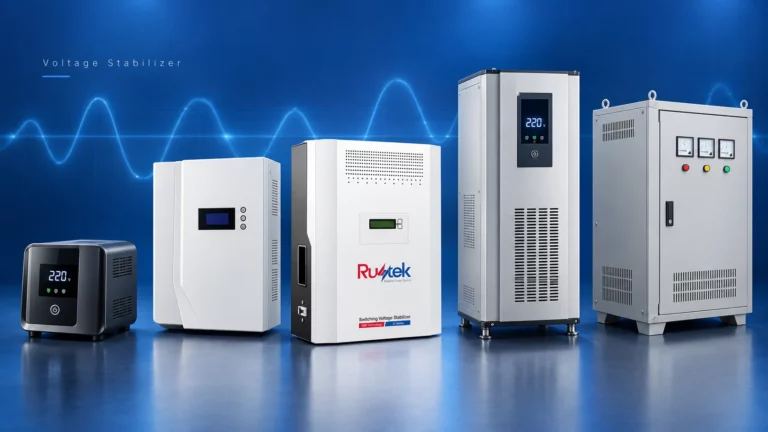
Servo-controlled stabilizers use an electromechanical adjustment system. They can provide smooth correction but contain moving components that require maintenance.
Relay-based stabilizers regulate voltage through switching arrangements. They are often economical, although their step size, switching behavior, and accuracy vary by model.
Static electronic stabilizers, including IGBT-based designs, use electronic power-control methods and can provide rapid regulation without a motorized adjustment mechanism. Their additional speed and precision may be valuable for sensitive systems but are not automatically necessary for every elevator.
No technology is universally best. Compare response time, output accuracy, overload performance, maintenance requirements, environmental limits, and compatibility with the elevator drive.
5. Review Protection and Bypass Features
Important considerations include phase-sequence monitoring, phase-loss protection, overload behavior, thermal protection, fault indication, and maintenance bypass. Modern elevator drives may also produce harmonics, while regenerative drives can return energy to the building supply. Confirm compatibility with both the stabilizer manufacturer and the elevator-system designer.
Voltage regulation does not eliminate harmonics and does not replace the safety and protection systems required by the elevator.
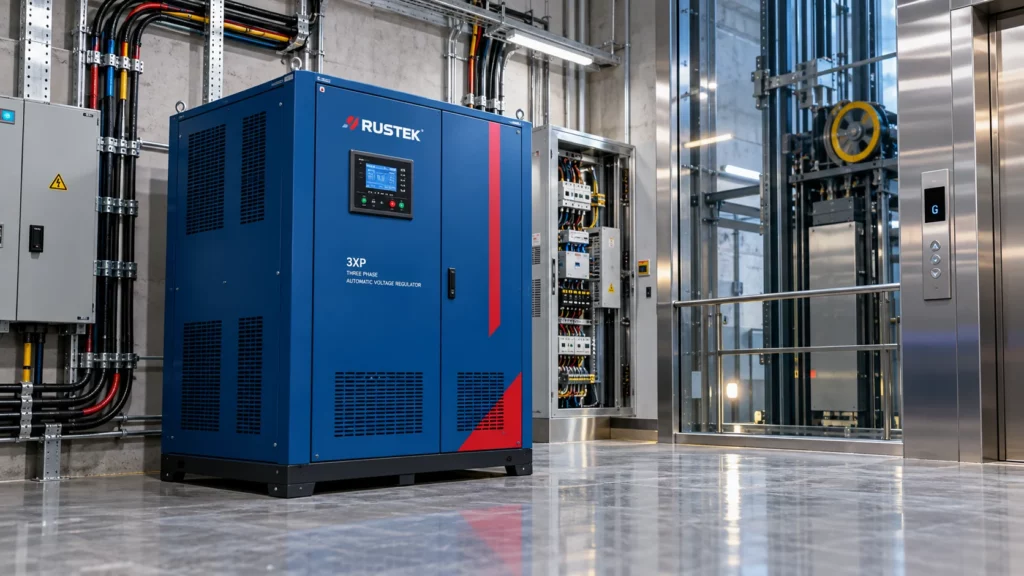
Rustek 3XP Three-Phase Stabilizers for Elevator Applications
The Rustek 3XP Series provides capacity options for three-phase elevator supplies, including 10, 20, 30, and 45 kVA models and larger 60, 80, 120, and 150 kVA industrial versions.
Depending on the model, available functions include:
- Independent voltage regulation for each phase
- Phase-sequence monitoring
- Adjustable power-up delay
- LCD monitoring and configuration
- Automatic regulation and bypass operation
- Fault monitoring, protection functions, and audible alerts
The published phase-voltage input range is 140–270 V for the 10–45 kVA models and 140–300 V for the 60–150 kVA models. These values are phase-to-neutral voltages, not line-to-line voltages.
Model selection must still be verified against the motor load, controller, drive configuration, starting demand, harmonics, and site conditions. Compare available models on the Rustek three-phase voltage stabilizer page.
Installation Matters as Much as Selection
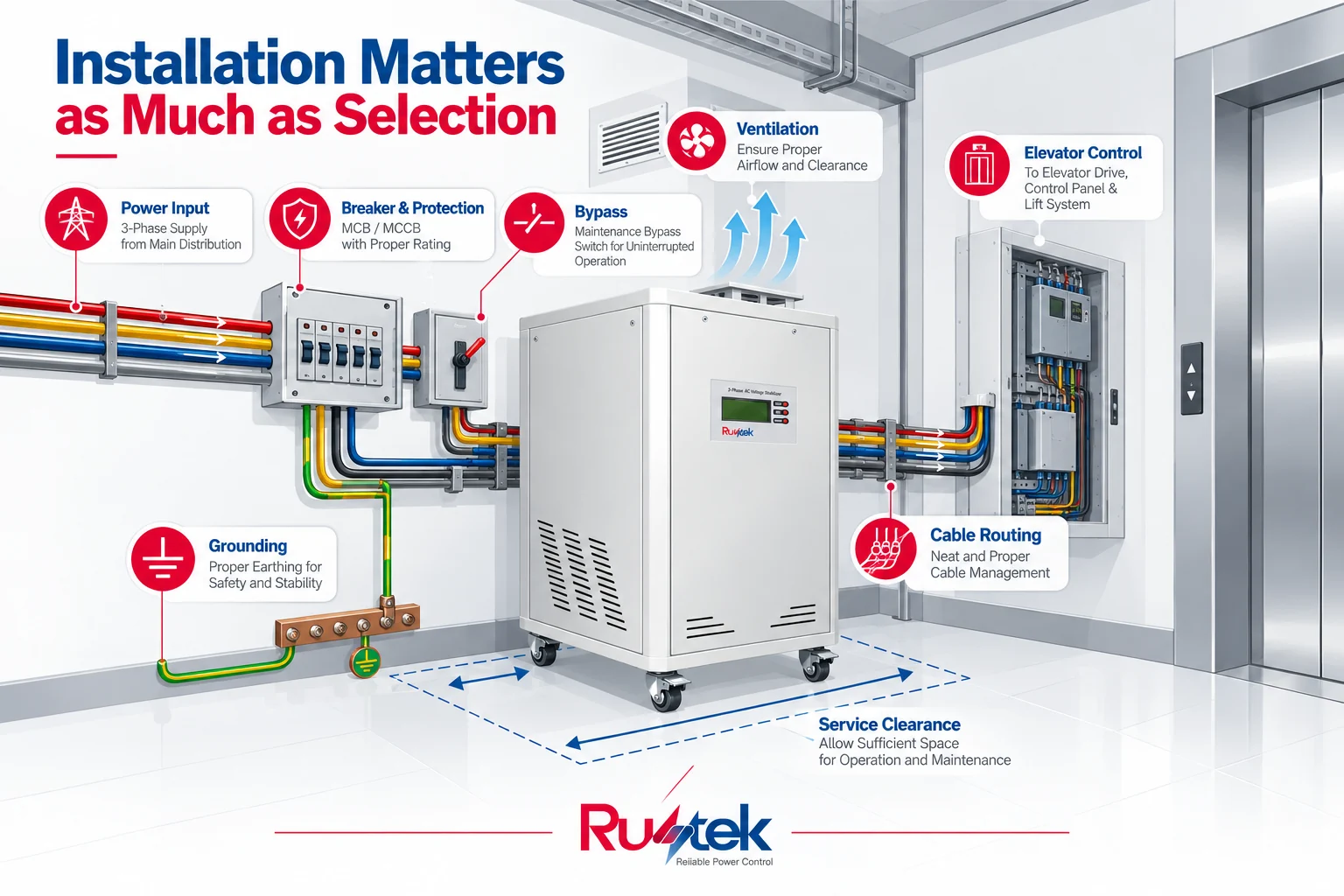
Even a correctly sized stabilizer can perform poorly in an unsuitable installation. A qualified electrical professional must determine the connection point, protective-device coordination, cable sizes, earthing, ventilation, bypass arrangement, and maintenance access.
The installation must preserve the elevator's existing safety circuits, emergency arrangements, and operating sequences. Automatic restart and power-up delay settings must be coordinated with the elevator controller. After installation, the complete system should be tested under both normal and demanding operating conditions.
Choose an Elevator Stabilizer from Measured Information
The best elevator stabilizer is not necessarily the largest or most expensive model. It is the one that matches the elevator's actual electrical requirements and the building's measured power conditions.
Before purchasing, collect the motor and drive specifications, voltage measurements for every phase, operating currents, starting behavior, and installation details. Rustek can then help identify which three-phase stabilizer models deserve closer technical evaluation.
Frequently Asked Questions
What size voltage stabilizer is required for an elevator?
Required capacity depends on measured electrical demand, motor starting characteristics, drive configuration, other connected loads, and the supply-voltage range. Motor power alone is not enough to select a reliable kVA rating.
Is a three-phase stabilizer suitable for every elevator?
No. It is suitable only for a compatible three-phase electrical system. Smaller lifts may use single-phase supplies, and specialized systems may have additional requirements.
Can a stabilizer keep an elevator running during a power outage?
No. A stabilizer regulates available voltage but does not store energy. Emergency rescue equipment or a properly designed backup-power system is required.